
Home / Guides / Silt fence installation
How to install silt fence on a construction site
On a site covered by EPA's 2022 Construction General Permit, silt fence used as a perimeter control goes downslope of exposed soil, on the contour, with both ends turned up the slope so water cannot run around it, and it must be working before earth disturbance starts above it. Sediment must come out before it reaches half the fence's above-ground height. EPA 2022 CGP Part 2.1.3, 2.2.3 EPA's silt fence fact sheet adds installation figures: posts driven 2 feet into the ground, the fabric buried in a 12-inch slit or a trench about 6 inches wide and 6 inches deep, and the soil compacted on both sides. EPA silt fence fact sheet, p. 3-4
National guide. The rules cited are from EPA's 2022 Construction General Permit (as modified in 2025), checked October 20, 2026, which applies where EPA is the permitting authority. Most states issue their own permit with different details; check your state before relying on a number.
Sources last checked October 19, 2026. Prepared by our team led by Mohamed Elansary, PhD, with AI research tools. We are not a licensed engineering firm and do not seal plans.
General information; your permit text controls. Not legal advice and not engineering judgment. We make no promise of permit coverage, agency acceptance or compliance.
What the permit requires
| Rule | EPA 2022 CGP |
|---|---|
| Where | Along perimeter areas downslope of any exposed soil or other disturbed areas, upgradient of any natural buffer. EPA 2022 CGP Part 2.2.3 |
| Shape | On the contour of the slope, with both ends extended up slope (for example at 45 degrees) in a crescent rather than a straight line. EPA 2022 CGP Part 2.2.3 |
| When | Installed and working before clearing, grading or excavating starts in the area it protects. EPA 2022 CGP Part 2.1.3 |
| Cleanout | Remove sediment before it accumulates to one-half of the above-ground height. EPA 2022 CGP Part 2.2.3 |
| After a storm | If water went around or under the fence, extend it or repair the undercut areas. EPA 2022 CGP Part 2.2.3 |
| Repairs | Start routine maintenance at once and finish by the close of the next business day; up to 7 calendar days only where that is documented as infeasible. EPA 2022 CGP Part 2.1.4 |
| Stockpiles | A sediment barrier, such as silt fence, along all downgradient sides of soil or debris piles. EPA 2022 CGP Part 2.2.5, footnote 27 |
| Linear sites | Where perimeter controls are infeasible in a limited right-of-way, use other practices to minimize discharges to perimeter areas. EPA 2022 CGP Part 2.2.3 |
EPA names silt fence as one example of a perimeter control, alongside filter berms, compost filter socks, gravel barriers and temporary diversion dikes. Wire-backed, super and multi-layer geotextile silt fence are listed as types. EPA 2022 CGP Part 2.2.3, footnote 21 The permit does not require silt fence by name.
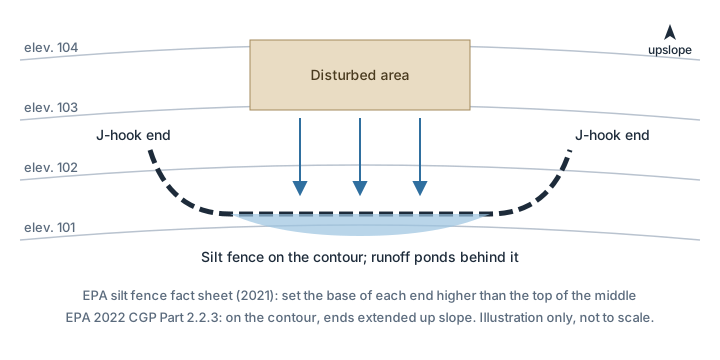
Installation steps from EPA's fact sheet
EPA's National Menu fact sheet on silt fences (EPA-832-F-21-028AA, December 2021) describes the practice. These are EPA's published figures, quoted for reference; your state manual or the product specification may set different ones. EPA silt fence fact sheet, p. 1-4
- Lay out the runs on the contour. Break the site into small storage areas; the drainage area above any fence should usually not exceed a quarter of an acre. Avoid long runs, which send water to one low point. EPA silt fence fact sheet, p. 1-2
- Turn the ends up. Use J-hooks to break up long runs, and set the bottom of each end higher than the top of the middle of the fence, so heavy flows go over the top rather than around the ends. EPA silt fence fact sheet, p. 2
- Keep it out of flowing channels. Do not place silt fence in a channel with continuous flow or across a narrow or steep-sided channel. On a long, steep slope, EPA suggests one fence near the head of the slope and another 6 to 10 feet from the toe. EPA silt fence fact sheet, p. 2
- Set the posts. Drive posts 2 feet into the ground. Space them 3 to 4 feet apart where water may run over the top, 5 feet in most other areas, and 6 to 7 feet where there is little horizontal load. EPA prefers steel posts because they can be driven 2 feet into compacted soil. EPA silt fence fact sheet, p. 3
- Bury the fabric. Either slice it in (a machine cuts a slit 12 inches deep and inserts the fabric) or trench it in (a trench about 6 inches wide and 6 inches deep). EPA cites a 2001 American Society of Civil Engineers verification in which static slicing did as well as or better than the highest-performing trenching variation, which took nearly triple the time and effort. EPA silt fence fact sheet, p. 3-4
- Compact both sides. For slicing, EPA describes rolling a tractor wheel along both sides of the slit 2 to 4 times. Poor compaction lets water flow under the fence. EPA silt fence fact sheet, p. 4
- Attach the fabric. The fence should support 24 inches of sediment and water. For steel posts, EPA describes three plastic ties per post (50-pound test strength) in the top 8 inches of the fabric; for wooden posts, several staples per post with a wood lath over the fabric. EPA silt fence fact sheet, p. 4
As a rough amount, EPA's fact sheet gives a rule of thumb of at least 100 feet of silt fence per 10,000 square feet of disturbed area, adjusted for soil, slope, slope length, rainfall and site layout. If fences overflow after a moderate rain, more fence is needed. EPA silt fence fact sheet, p. 3
Inspection and removal
Inspect silt fence with the rest of the site on the permit's schedule; under EPA's permit that is every 7 days, or every 14 days and within 24 hours of 0.25 inches of rain. EPA 2022 CGP Part 4.2 EPA's fact sheet suggests removing sediment at half the fence height or installing a second fence, and removing the fence once the area is permanently stabilized. EPA silt fence fact sheet, p. 6 Before filing a Notice of Termination under EPA's permit, you remove the stormwater controls installed during construction unless they are biodegradable or meant for long-term use. EPA 2022 CGP Part 8.2.1
What goes in the SWPPP
- Each perimeter control, its design specifications (manufacturer specifications or the erosion control manual relied on), maintenance and installation schedule. EPA 2022 CGP Part 7.2.6
- The location of every stormwater control on the site map. EPA 2022 CGP Part 7.2.4
State differences
| Permit | Silt fence rule |
|---|---|
| Texas TXR150000 | At a minimum, silt fences, vegetative buffer strips or equivalent sediment controls on all downslope boundaries of the construction area, for drainage areas of 10 acres or more and under 10 acres alike, plus side slopes where site conditions call for it. TXR150000 Part III.F.2(c)i(B), ii(A) Trapped sediment removed before it reaches 50% of the above-ground height. TXR150000 Part III.F.6(c) |
| Mississippi MSR10 | Steep slopes that cannot be avoided need, at a minimum, silt fences or equivalent sediment controls on all downslope boundaries, unless a sediment basin is provided with storage for the 2-year, 24-hour storm or 3,600 cubic feet per acre drained. MSR10 ACT5 T-7(D) |
Other states set their own specifications, often in a state erosion control manual; check your state hub: Alaska, Arizona, Arkansas, Colorado, Florida, Hawaii, Idaho, Illinois, Indiana, Iowa, Kentucky, Louisiana, Massachusetts, Michigan, Mississippi, Nebraska, Nevada, New Hampshire, New York, North Dakota, Ohio, Oklahoma, Oregon, South Carolina, South Dakota, Texas, Utah, Washington, West Virginia. Related: construction stormwater BMPs by type, sediment basins, SWPPP inspection requirements.
Our plans name each perimeter control, where it goes on the site map and how it is maintained, for the permit that covers your site. We do not install or inspect controls.
What this page does not cover
Product selection, installation pricing, engineered sediment controls and local specifications. The installation figures are EPA's published guidance, not permit requirements; your state manual, local rules and the product specification control.
Have it written for you
SWPPP Desk prepares site-specific SWPPPs from your drawings for construction sites in the states we cover (coverage by state), for a fixed price, delivered the next business day after your inputs are complete. Small site (1 to under 5 acres): $449. Large site (5 acres or more): $749. Background: all guides.
Related guides
- What is a SWP3?
- What is a SWPPP?
- SW3P, SWP3 and SWPPP: the same plan
- TCEQ SWPPP requirements
- TXR150000: the Texas construction general permit
- TCEQ stormwater permit for construction
- TCEQ NOI: filing in STEERS
- What goes in a SWPPP plan
- SWPPP template: EPA and state templates
- SWPPP inspection requirements
- SWPPP inspection form
- Erosion control plan requirements
- Who needs a SWPPP?
- Notice of Intent (NOI) for construction stormwater
- Notice of Termination (NOT)
- SWPPP sign and site notice
- Construction stormwater BMPs by type
- SWPPP cost: our prices and public prices
- PROPOSED 2027 EPA CGP: what re-filing looks like
- TXR150000 renewal: the permit expires March 5, 2028
- Sediment basin requirements
- Concrete washout rules
- Construction dewatering
- SWPPP site map requirements